Showing posts with label Hackers. Show all posts
Showing posts with label Hackers. Show all posts
Wednesday, 19 June 2013


Wednesday, 6 March 2013
100+ Websites Hacked And Defaced by Widex
100+ Websites Hacked And Defaced by Widex. Most of there targets are US and Indian sites. There are no main idea about their hack but one thing for sure that this kind of hacks create lot of questions for security experts. Every years hacker are becoming more powerful than previous year. It seems like whole server is rooted and mass defaced.
The list of impacted sites and mirrors was published on Pastebin , at press time, all of them still weren’t restored.

Follow @TheHackersMediaThe list of impacted sites and mirrors was published on Pastebin , at press time, all of them still weren’t restored.

Hacked Sites:
Mirrors:
http://hack-mirror.com/hacker/Sunday, 17 February 2013
130+ Indian & American Sites Hacked & Defaced by Drac-101code
130+ Indian & American Sites Hacked & Defaced by Drac-101code. Most of there targets are US and Indian sites. There are no main idea about their hack but one thing for sure that this kind of hacks create lot of questions for security experts. Every years hacker are becoming more powerful than previous year.

root@server:/root # ooh, 404?. That Mean ur site exploited :)!
root@server:/root # ..........HACKED BY Drac-101code
root@server:/root # cyberxteam@asia.com
root@server:/root # http://cyberxteam.org
root@server:/root # ......................>!
root@server:/root # Do you wont the reason?!
root@server:/root # ......................>!
root@server:/root # There Is Not Patch To Human Stupidity
root@server:/root # Loading..........
root@server:/root # Loading..........
root@server:/root # Loading..........
root@server:/root # ..........Locked!
root@server:/root # (abort)
root@server:/root # Completed! ...
root@server:/root # #..........Drac-101code Was Here !
root@server:/root # #..........<......................>> - Im Ow'ned You !
root@server:/root # http://manusia-biasa.org
root@server:/root # Thanks To: Allah SWT - Nabi Muhammad SAW - Raka Satria - Submit Defacer Team.
root@server:/root # | K4C3 Undetected | Doza Cracker | Drac-101code | E5a_Cyb3r | Rifqi 3103 | Xrootx | Abraut | Dmustcyber4rt | Fuad 07 Lekx | ct2Xars |."
http://top10luxurytreatmentcenters.com/id/
http://treatmentforalcoholdependence.com/id/
http://treatmentforbenzodiazepines.com/id/
http://treatmentforhydrocodone.com/id/
http://treatmentforpanicdisorders.com/id/
http://treatmentforroxycodone.com/id/
http://www.treatmentforvalium.com/id/
http://unitedhealthcaredrugtreatment.com/id/
http://venturacountyrehab.com/id/
http://westbloomfieldtownshipdrugrehab.com/id/
http://yorbalindadrugrehab.com/id/
http://affordable-addiction-treatment.com/id/
http://affordable-rehab-center.com/id/
http://affordabletreatmentcenter.com/id/
http://alcoholrehabbrentwood.com/id/
http://alcoholrehabventura.com/id/
http://aspenhilldrugrehab.com/id/
http://behavioraldisorderstreatment.com/id/
http://behaviordisorderstreatment.com/id/
http://benzodiazepinesdetox.com/id/
http://berkeley-drugrehab.com/id/
http://bestsuccessrateaddictiontreatmentcenter.com/id/
http://bestsuccessratedrugrehab.com/id/
http://bestsuccessraterehab.com/id/
http://bestusadrugrehab.com/id/
http://bloomingtondrugrehab.com/id/
http://brooklinedrugrehab.com/id/
http://calabasasdrugrehab.com/id/
http://calvertcountydrugrehab.com/id/
http://camarillodrugrehab.com/id/
http://carlsbad-drugrehab.com/id/
http://carrolltondrugrehab.com/id/
http://carydrugrehab.com/id/
http://castrovalleydrugrehab.com/id/
http://centurycitydrugrehab.com/id/
http://centurycityoutpatientrehabs.com/
http://cerritosdrugrehab.com/id/
http://chappaquadrugrehab.com/id/
http://cignadrugtreatment.com/id/
http://claytondrugrehab.com/id/
http://columbiadrugrehab.com/id/
http://cotodecazadrugrehab.com/id/
http://dallasaddictiontreatmentcenter.com/id/
http://depressionrehabcenter.com/id/
http://depressionrehabfacilities.com/id/
http://detoxfromatavan.com/id/
http://detoxfromativan.com/id/
http://detoxfromcodeine.com/id/
http://detoxfromdrugsandalcohol.com/id/
http://detoxfrommeth.com/id/
http://detoxfromnorco.com/id/
http://detoxfromsubutex.com/id/
http://douglascountydrugrehab.com/id/
http://drugrehabbartonhills.com/id/
http://drugrehabbocapointe.com/id/
http://drugrehabcoveneck.com/id/
http://drugrehabfairfaxcounty.com/id/
http://drugrehabgulfstream.com/id/
http://drugrehabhalibutcove.com/id/
http://drugrehabhardingtownship.com/id/
http://drugrehabhenlopenacres.com/id/
http://drugrehabhunterscreekvillage.com/id/
http://drugrehabnorthoaks.com/id/
http://drugrehabpineypointvillage.com/
http://drugrehabriverwoods.com/id/
http://drugrehabsouthbeach.com/id/
http://drugrehabsouthlake.com/id/
http://drugtreatmentcenterporthueneme.com/id/
http://dualdiagnosisdrugtreatment.com/id/
http://encinodrugrehab.com/id/
http://glenviewdrugrehab.com/id/
http://greenwichalcoholrehab.com/id/
http://www.highestsuccessratedrugrehab.com/id/
http://highestsuccessratedrugtreatment.com/id/
http://inpatientdrugtreatmentcenter.com/id/
http://intensiveoutpatientdrugrehab.com/id/
http://losaltoshillsdrugrehab.com/id/
http://luxuryanxietytreatment.com/id/
http://luxuryeatingdisordertreatment.com/id/
http://luxuryrehabfacility.com/id/
http://malibuoutpatientprogram.com/id/
http://marincountyalcoholrehab.com/id/
http://newtondrugrehab.com/id/
http://northhillsdrugrehab.com/id/
http://northpotomacdrugrehab.com/id/
http://www.outpatientalcoholismtreatment.com/id/
http://outpatientdrugabuserehab.com/id/
http://outpatientdrugtreatmentcenter.com/id/
http://pacificpalisadesrehab.com/id/
http://prescriptiondrugabusetreatmentcenter.com/id/
http://rehabcalabasas.com/id/
http://rehabsantamonica.com/id/
http://sausalitodrugrehab.com/id/
http://shermanoaksdrugrehab.com/id/
http://somersetcountydrugrehab.com/id/
http://southsanfranciscodrugrehab.com/id/
http://studiocitydrugrehab.com/id/
http://sunnyvaledrugrehab.com/id/
http://www.reitechnosoft.com/
http://hirejaipur.com/
http://papadkehanumanji.com/
http://rei-technologies.com/
http://rsgbc.in/
http://ssconstructiongroup.com/
http://supremechemicals.in/
http://thehelpinghandsgroup.com/
http://myfundays.in/
http://corderosa.in/
http://assambulkcarrier.com/
http://bushpark.in/
http://creativehub.info/
http://designersfab.com/
http://ezeejobz.com/
http://fork13.com/
http://hanswahini.org/
http://hiringsolutions.in/
http://ihepa.in/
http://jjindia.co.in/
http://katiharyellowpages.in/
http://lightways.in/
http://neevantabuilders.com/
http://neevantaconstructions.com/
http://nickelring.com/
http://pankajnidhi.com/
http://rayssolutions.com/
http://romil.in/
http://shrisudarshanjimaharaj.org/
http://suncinelight.com/
http://suture.co.in/
http://svear.org/
http://www.tallyretail.com/
http://tuubol.com/
http://www.joomla-only.ru/images/
Mirrors:
http://www.zone-h.org/archive/notifier=Drac-101code
Follow @TheHackersMedia
Deface Page Say's:
"root@server:/root # query result: error - 404root@server:/root # ooh, 404?. That Mean ur site exploited :)!
root@server:/root # ..........HACKED BY Drac-101code
root@server:/root # cyberxteam@asia.com
root@server:/root # http://cyberxteam.org
root@server:/root # ......................>!
root@server:/root # Do you wont the reason?!
root@server:/root # ......................>!
root@server:/root # There Is Not Patch To Human Stupidity
root@server:/root # Loading..........
root@server:/root # Loading..........
root@server:/root # Loading..........
root@server:/root # ..........Locked!
root@server:/root # (abort)
root@server:/root # Completed! ...
root@server:/root # #..........Drac-101code Was Here !
root@server:/root # #..........<......................>> - Im Ow'ned You !
root@server:/root # http://manusia-biasa.org
root@server:/root # Thanks To: Allah SWT - Nabi Muhammad SAW - Raka Satria - Submit Defacer Team.
root@server:/root # | K4C3 Undetected | Doza Cracker | Drac-101code | E5a_Cyb3r | Rifqi 3103 | Xrootx | Abraut | Dmustcyber4rt | Fuad 07 Lekx | ct2Xars |."
Hacked Sites List:
http://thousandoaksdrugrehab.com/id/http://top10luxurytreatmentcenters.com/id/
http://treatmentforalcoholdependence.com/id/
http://treatmentforbenzodiazepines.com/id/
http://treatmentforhydrocodone.com/id/
http://treatmentforpanicdisorders.com/id/
http://treatmentforroxycodone.com/id/
http://www.treatmentforvalium.com/id/
http://unitedhealthcaredrugtreatment.com/id/
http://venturacountyrehab.com/id/
http://westbloomfieldtownshipdrugrehab.com/id/
http://yorbalindadrugrehab.com/id/
http://affordable-addiction-treatment.com/id/
http://affordable-rehab-center.com/id/
http://affordabletreatmentcenter.com/id/
http://alcoholrehabbrentwood.com/id/
http://alcoholrehabventura.com/id/
http://aspenhilldrugrehab.com/id/
http://behavioraldisorderstreatment.com/id/
http://behaviordisorderstreatment.com/id/
http://benzodiazepinesdetox.com/id/
http://berkeley-drugrehab.com/id/
http://bestsuccessrateaddictiontreatmentcenter.com/id/
http://bestsuccessratedrugrehab.com/id/
http://bestsuccessraterehab.com/id/
http://bestusadrugrehab.com/id/
http://bloomingtondrugrehab.com/id/
http://brooklinedrugrehab.com/id/
http://calabasasdrugrehab.com/id/
http://calvertcountydrugrehab.com/id/
http://camarillodrugrehab.com/id/
http://carlsbad-drugrehab.com/id/
http://carrolltondrugrehab.com/id/
http://carydrugrehab.com/id/
http://castrovalleydrugrehab.com/id/
http://centurycitydrugrehab.com/id/
http://centurycityoutpatientrehabs.com/
http://cerritosdrugrehab.com/id/
http://chappaquadrugrehab.com/id/
http://cignadrugtreatment.com/id/
http://claytondrugrehab.com/id/
http://columbiadrugrehab.com/id/
http://cotodecazadrugrehab.com/id/
http://dallasaddictiontreatmentcenter.com/id/
http://depressionrehabcenter.com/id/
http://depressionrehabfacilities.com/id/
http://detoxfromatavan.com/id/
http://detoxfromativan.com/id/
http://detoxfromcodeine.com/id/
http://detoxfromdrugsandalcohol.com/id/
http://detoxfrommeth.com/id/
http://detoxfromnorco.com/id/
http://detoxfromsubutex.com/id/
http://douglascountydrugrehab.com/id/
http://drugrehabbartonhills.com/id/
http://drugrehabbocapointe.com/id/
http://drugrehabcoveneck.com/id/
http://drugrehabfairfaxcounty.com/id/
http://drugrehabgulfstream.com/id/
http://drugrehabhalibutcove.com/id/
http://drugrehabhardingtownship.com/id/
http://drugrehabhenlopenacres.com/id/
http://drugrehabhunterscreekvillage.com/id/
http://drugrehabnorthoaks.com/id/
http://drugrehabpineypointvillage.com/
http://drugrehabriverwoods.com/id/
http://drugrehabsouthbeach.com/id/
http://drugrehabsouthlake.com/id/
http://drugtreatmentcenterporthueneme.com/id/
http://dualdiagnosisdrugtreatment.com/id/
http://encinodrugrehab.com/id/
http://glenviewdrugrehab.com/id/
http://greenwichalcoholrehab.com/id/
http://www.highestsuccessratedrugrehab.com/id/
http://highestsuccessratedrugtreatment.com/id/
http://inpatientdrugtreatmentcenter.com/id/
http://intensiveoutpatientdrugrehab.com/id/
http://losaltoshillsdrugrehab.com/id/
http://luxuryanxietytreatment.com/id/
http://luxuryeatingdisordertreatment.com/id/
http://luxuryrehabfacility.com/id/
http://malibuoutpatientprogram.com/id/
http://marincountyalcoholrehab.com/id/
http://newtondrugrehab.com/id/
http://northhillsdrugrehab.com/id/
http://northpotomacdrugrehab.com/id/
http://www.outpatientalcoholismtreatment.com/id/
http://outpatientdrugabuserehab.com/id/
http://outpatientdrugtreatmentcenter.com/id/
http://pacificpalisadesrehab.com/id/
http://prescriptiondrugabusetreatmentcenter.com/id/
http://rehabcalabasas.com/id/
http://rehabsantamonica.com/id/
http://sausalitodrugrehab.com/id/
http://shermanoaksdrugrehab.com/id/
http://somersetcountydrugrehab.com/id/
http://southsanfranciscodrugrehab.com/id/
http://studiocitydrugrehab.com/id/
http://sunnyvaledrugrehab.com/id/
http://www.reitechnosoft.com/
http://hirejaipur.com/
http://papadkehanumanji.com/
http://rei-technologies.com/
http://rsgbc.in/
http://ssconstructiongroup.com/
http://supremechemicals.in/
http://thehelpinghandsgroup.com/
http://myfundays.in/
http://corderosa.in/
http://assambulkcarrier.com/
http://bushpark.in/
http://creativehub.info/
http://designersfab.com/
http://ezeejobz.com/
http://fork13.com/
http://hanswahini.org/
http://hiringsolutions.in/
http://ihepa.in/
http://jjindia.co.in/
http://katiharyellowpages.in/
http://lightways.in/
http://neevantabuilders.com/
http://neevantaconstructions.com/
http://nickelring.com/
http://pankajnidhi.com/
http://rayssolutions.com/
http://romil.in/
http://shrisudarshanjimaharaj.org/
http://suncinelight.com/
http://suture.co.in/
http://svear.org/
http://www.tallyretail.com/
http://tuubol.com/
http://www.joomla-only.ru/images/
Mirrors:
http://www.zone-h.org/archive/notifier=Drac-101code
Saturday, 19 January 2013
RIP Aaron Swartz Legacy
In 1970, a 14-year-old boy dialed into a nationwide computer network, uploaded a virus he had written and caused the entire network to crash.
That boy was Bill Gates. Five years later, he founded Microsoft.
A few years later, two young men went around college dorms in California selling boxes of wires that let students bypass telephone-company restrictions and make long-distance calls for free.
Those young men were Steve Jobs and Steve Wozniak, and a later venture they started, Apple, is now the most valuable company in the world.
In 2010, another young man, who had already founded a multimillion-dollar company, broke into a utility closet at the Massachusetts Institute of Technology.
He hooked up a laptop to the campus network and downloaded 4 million academic journal articles, most of them in the public domain, from a paid archive to which he had a subscription.
He was arrested, indicted twice on multiple counts of fraud and, at a trial that was to have begun in April, faced 50 years in federal prison and a $1 million fine.
Very sadly Aaron Swartz has committed suicide on January 11, 2013 in New York City in age of 26.

Aaron was a computer geek and hacker, Who always rise his voice for freedome of internet. Aaron created RSS Web feed system when he was only 14 years old.
He believed in freedom of internet and free information. Knowledge must be shared. He was one of leading person in fight against SOPA. He warned "“SOPA will have yet another name, and maybe a different excuse, and probably do its damage in a different way. But make no mistake: The enemies of the freedom to connect have not disappeared. Next time they might just win. Let’s not let that happen.”
Aaron was mentally torched at the time of his death. He was punished for 35 years in federal prison for hacking the MIT system to gain access to millions of scholarly articles from JSTOR to make public and free for all.

On Saturday, Swartz’s family released a statement
"Aaron’s death is not simply a personal tragedy. It is the product of a criminal justice system rife with intimidation and prosecutorial overreach. Decisions made by officials in the Massachusetts U.S. Attorney’s office and at MIT contributed to his death. The US Attorney’s office pursued an exceptionally harsh array of charges, carrying potentially over 30 years in prison, to punish an alleged crime that had no victims."
Hackers for all around the world started the #OpAaronSwartz to shut down the MIT and department of Justice Websites using DDOS.
Follow @TheHackersMediaThat boy was Bill Gates. Five years later, he founded Microsoft.
A few years later, two young men went around college dorms in California selling boxes of wires that let students bypass telephone-company restrictions and make long-distance calls for free.
Those young men were Steve Jobs and Steve Wozniak, and a later venture they started, Apple, is now the most valuable company in the world.
In 2010, another young man, who had already founded a multimillion-dollar company, broke into a utility closet at the Massachusetts Institute of Technology.
He hooked up a laptop to the campus network and downloaded 4 million academic journal articles, most of them in the public domain, from a paid archive to which he had a subscription.
He was arrested, indicted twice on multiple counts of fraud and, at a trial that was to have begun in April, faced 50 years in federal prison and a $1 million fine.
Very sadly Aaron Swartz has committed suicide on January 11, 2013 in New York City in age of 26.

Aaron was a computer geek and hacker, Who always rise his voice for freedome of internet. Aaron created RSS Web feed system when he was only 14 years old.
He believed in freedom of internet and free information. Knowledge must be shared. He was one of leading person in fight against SOPA. He warned "“SOPA will have yet another name, and maybe a different excuse, and probably do its damage in a different way. But make no mistake: The enemies of the freedom to connect have not disappeared. Next time they might just win. Let’s not let that happen.”
Aaron was mentally torched at the time of his death. He was punished for 35 years in federal prison for hacking the MIT system to gain access to millions of scholarly articles from JSTOR to make public and free for all.

On Saturday, Swartz’s family released a statement
"Aaron’s death is not simply a personal tragedy. It is the product of a criminal justice system rife with intimidation and prosecutorial overreach. Decisions made by officials in the Massachusetts U.S. Attorney’s office and at MIT contributed to his death. The US Attorney’s office pursued an exceptionally harsh array of charges, carrying potentially over 30 years in prison, to punish an alleged crime that had no victims."
Hackers for all around the world started the #OpAaronSwartz to shut down the MIT and department of Justice Websites using DDOS.
Thursday, 13 September 2012
The 10 Most Infamous Student Hackers of All Time
Hacking has always been inherently a young person’s game. The first usage of the word “hacker” was to describe pranksters meddling with the phones at MIT. Many hackers have cited boredom, a desire for change, or the thrill of going somewhere one is not supposed to go as their motivation for hacking, all of which could apply to scores of common activities on college campuses. While today’s hacking scene is dominated by large hacking groups like Anonymous and Masters of Deception, many of the greatest hacks ever have been pulled off by college, high school, and even middle school kids who rose to infamy armed only with a computer and the willingness to cross the bounds of legality.

Follow @thehackersmedia
- Sven Jaschan:In the words of one tech expert, “His name will always be associated with some of the biggest viruses in the history of the Internet.” The viruses: the Sasser and NetSky worms that infected millions of computers and have caused millions of dollars of damage since their release in 2004. The man behind the viruses proved to be not even a man at all, legally. Seventeen-year-old hacker Sven Jaschan, a student at a computer science school in Germany, claimed to have created the viruses to become a hero by developing a program that would eradicate the rampaging Mydoom and Bagle bugs. Instead he found himself the subject of a $250,000 bountycourtesy of Microsoft, for which some of his classmates turned him in.
- Jonathan James:In 2000, at the age of 16, James, or “C0mrade” as he was known in the hacker community, infamously became the first juvenile federally sentenced for hacking. The targets of his notorious hack jobs were a wing of the U.S. Department of Defense called the Defense Threat Reduction Agency, NASA, and the Marshall Space Flight Center in Huntsville, Ala. (By hacking the latter James gained the ability to control the A/C in the International Space Station.) All of these were pulled off “for fun” while James was still a student at Palmetto Senior High in Miami. Unfortunately, the fun ran out when James was tied into a massive identity theft investigation. Though insisting he was innocent, James took his own life, saying he had “no faith in the justice system.”
- Michael Calce:Yahoo. CNN. Ebay. Amazon. Dell.com. One by one in a matter of days, these huge websites crashed at the hands of 15-year-old Canadian high school student Michael Calce, aka “MafiaBoy.” Armed with a denial-of-service program he called “Rivolta” that overloaded servers he targeted, the young hacker wreaked $7.5 million in damages, according to court filings. Calce was caught when he fell victim to a common ailment of teenage boys: bragging. The cops were turned on to him when he began boasting in chat rooms about being responsible for the attacks. On Sept. 12, 2001, MafiaBoy was sentenced to a group facility for eight months on 56 counts of cybercrime.
- Kevin Mitnick:Before performing hacks that prompted the U.S. Department of Justice to declare him “the most wanted computer criminal in United States history,” Kevin Mitnick had already made a name for himself as a hacker in his school days, first at Monroe High School in LA and later at USC. On a dare, Mitnick connived an opening into the computer system of Digital Equipment Corporation, which some fellow hackers then used to steal proprietary source code from the company before ratting on him. While still on probation for that crime, Mitnick broke into the premises of Pacific Bell and had to go on the run from police in the aftermath, during which time he hacked dozens of systems, including those of IBM, Nokia, Motorola, and Fujitsu.
- Tim Berners-Lee:“Scandalous” is a synonym for “infamous,” and for this legendary computer scientist, knight of the British Empire, and inventor of the World Wide Web to have been a hacker in his school days is certainly a juicy factoid. During his time at Oxford in the mid-’70s, Sir Tim was banned from using university computers after he and a friend were caught hacking their way into restricted digital areas. Luckily by that time he already knew how to make his own computer out of a soldering iron, an old TV, and some spare parts. And also luckily for him, he will always be revered as the father of the Internet.
- Neal Patrick and the 414s:In the early ’80s, hacking was still a relatively foreign concept to most Americans. Few recognized the enormous power hackers could hijack with a few strokes on a keyboard, which explains why a young group of hackers known as the 414s (after a Milwaukee area code) were virtual celebrities after they hacked into the famous Los Alamos National Laboratory, the Memorial Sloan-Kettering Cancer Center, and elsewhere. While today hacking a lab where classified nuclear research is conducted could earn you a one-way ticket to Guantanamo, the 17-year-old ringleader and high school student Neal Patrick was on the cover of Newsweek. The group members got light sentences but prompted Congress to take a stronger role in cybercrime.
- Robert T. Morris:The first ever Internet worm, the Morris Worm derived its name from Cornell grad student Robert Tappan Morris. In 1988, Morris released the worm through MIT’s system to cover his tracks, which would seem to contradict his claims that he meant no harm with it. But that’s exactly what resulted: the worm spread out of control, infecting more than 6,000 computers connected to the ARPANET, the academic forerunner to the World Wide Web. The damages reached as high as an estimated $10 million, and Morris earned the ignominious distinction of being the first person prosecuted under the Computer Fraud and Abuse Act. Morris got community service but was apparently not considered too infamous to be offered his current job as a professor at MIT.
- George Hotz:To some, George Hotz (aka “geohot,” aka “million75,” aka “mil”) is a public menace, a threat to electronic businesses everywhere. To many, Hotz is a hero. The high-schooler shot to fame/infamy in 2007 at the tender age of 17 by giving the world its first hacked, or “jailbroken” iPhone. He traded it for a new sports car and three new iPhones, and the video of the hacking received millions of hits. Apple has had to grudgingly come to terms with jailbreaking, seeing as the courts have declared it legal, but Sony Corp. is definitely not OK with such tampering. When Hotz hacked his PlayStation 3 and published the how-to on the web, the company launched a vicious lawsuit against him. In turn, the hacker group Anonymous launched an attack on Sony, stealing millions of users’ personal info.
- Donncha O’Cearbhaill:According to the FBI, this 19-year-old freshman at Trinity College Dublin is one of the top five most wanted hackers in the world. Well, he was; now that he’s been arrested he’s not really “wanted” anymore. The Feds contend the young man is a VIP member of the Anonymous and LulzSec hacking groups that have already been mentioned and whose targets have included the FBI, the U.S. Senate, and Sony (in the Hotz backlash). It seems “Palladium” (O’Cearbhaill) took the liberty of listening in on a conference call between the FBI and several international police forces who were discussing their investigations of the hacking groups. He could be sentenced to up to 15 years in prison if convicted for that hack alone.
- Nicholas Allegra:Just as George Hotz moved on from the Apple hacking game, Brown University student Nicholas Allegra is also hanging up his jersey. “Comex,” as he is known to millions of rooted iPhone fans, created the simple-to-use Apple iOS jailbreaking program JailbreakMe in 2007 and has since released two newer versions of it. However, Comex seems to have gone over to the dark side,accepting an internship with the very company whose products he became famous exploiting. Still, Allegra’s hacking skills are so advanced (one author puts him five years ahead of the authors of the infamous Stuxnet worm that corrupted Iran’s nuclear facilities) and so many people availed themselves of his talents, he will forever live in hacking infamy.Source: Link
Saturday, 25 August 2012
NSA top spy going to Defcon 2012
General Keith Alexander, director of the National Security Agency (NSA), will speak at the Defcon conference, the Pentagon affirmed.
General Keith B. Alexander is also the current Commander, United States Cyber Command.
Defcon for those of you who don’t know is a community of “hackers.”

Not to be confused with “crackers”.
Hackers, are a whole sub culture within American society.
They come to the conference to network, socialize and compete in hacking contests. They represent diverse demographics…
“Defcon is a self evolving group, constantly changing.”, said one hacker, who wished not to be identified
General Alexander may also be doing some intelligence gathering?
After all he spend most of his adult life in Army intelligence.
So as to be balanced, you should probably also watch a excellent scene in the movie Good Will Hunting before you decide to join NSA (see video: Why shouldn’t I work at the NSA (see video:)
According to Defcon employees “We’re going to show him the conference. If he wants to wander around…”
“It should be really cool”, said Jeff Moss of Defcon.
Speaking in reference to the speech Moss said:
“Don’t you think it’s important to hear what the most senior person at the NSA has to say? I’m interested in hearing what he has to say.”
He may be right. I don’t know?
Its no secret that Defcon is promoting this speaker at the conference.
Despite what you may think there are some serious discussions go on at Defcon conferences.
The topics range ever year from everything from computer intrusion, viruses to protecting your credit card information from being scanned by people walking down the street.
Reference: Link1
Follow @thehackersmediaGeneral Keith B. Alexander is also the current Commander, United States Cyber Command.
Defcon for those of you who don’t know is a community of “hackers.”

Not to be confused with “crackers”.
Hackers, are a whole sub culture within American society.
They come to the conference to network, socialize and compete in hacking contests. They represent diverse demographics…
“Defcon is a self evolving group, constantly changing.”, said one hacker, who wished not to be identified
General Alexander may also be doing some intelligence gathering?
After all he spend most of his adult life in Army intelligence.
So as to be balanced, you should probably also watch a excellent scene in the movie Good Will Hunting before you decide to join NSA (see video: Why shouldn’t I work at the NSA (see video:)
According to Defcon employees “We’re going to show him the conference. If he wants to wander around…”
“It should be really cool”, said Jeff Moss of Defcon.
Speaking in reference to the speech Moss said:
“Don’t you think it’s important to hear what the most senior person at the NSA has to say? I’m interested in hearing what he has to say.”
He may be right. I don’t know?
Its no secret that Defcon is promoting this speaker at the conference.
Despite what you may think there are some serious discussions go on at Defcon conferences.
The topics range ever year from everything from computer intrusion, viruses to protecting your credit card information from being scanned by people walking down the street.
Reference: Link1
Becoming Hackers Aren’t Tougher, You Just Have All The Right Tool
These days, hacking seems so common. It’s like a week won’t pass without hearing news about another site being hacked or passwords being leaked. So the situation begs the
Follow @thehackersmediaquestions, “Are passwords getting weaker or are hackers getting tougher?”

To be vigilant in choosing and keeping passwords secured. There are a lot of techniques in doing this like periodically changing your passwords, not telling everyone what your password is, using capital letters interchangeably with characters, numbers, etc. But all these efforts will be for naught if the site doesn’t salt your passwords. Salting passwords means they’re encrypting them so that it can’t be easily acquired. Most sites these days encrypt their users’ passwords but there are still some sites who do without salting. So how come passwords still get hacked if they’re encrypted? The answer is simple: hacking is now made easy.
It’s just that hackers these days have more hacking tools to aide them in their mission. Before, when hacking wasn’t that popular and computers aren’t that fast, hackers used a small list of passwords to guess user passwords. But as the time changed, the list grew. You’d think that hackers would have a tougher time cracking passwords since there’s now a bigger list to go through but you must not forget that computers these days are faster and can churn millions of data at the blink of an eye. Plus the fact that there are a lot of cracking software available these days, acquiring passwords may just be a walk in the park some.
There are two things you need to remember if you want to acquire passwords. First, if you do manage to get passwords of a certain site, there’s a huge possibility that it won’t be of any use to you since it’s hashed. Remember, sites encrypt passwords. So if a user uses the word “password” the hacker won’t see “password” but a code like “dzportsjd342nse9339f93qnnfgk134nsk4g” (not actual code) so he then needs to figure out what the code means before the password can be of any use to him. This is the reason why security companies often remind consumers to use an alphanumeric password, or inject some characters into them and avoid using obvious ones like your name and birthday, so hackers won’t easily access your account. Another thing to remember is to use different passwords for every site so in case one of your accounts gets compromised, your other accounts will still be secured.
The point is, users aren’t to blame if their accounts get hacked, it also doesn’t mean that the security measures of the service you are using is not commendable, hackers just have all the tools they need to do the task. So don’t beat yourself up. Still, it wouldn’t hurt if you make your passwords tougher.

To be vigilant in choosing and keeping passwords secured. There are a lot of techniques in doing this like periodically changing your passwords, not telling everyone what your password is, using capital letters interchangeably with characters, numbers, etc. But all these efforts will be for naught if the site doesn’t salt your passwords. Salting passwords means they’re encrypting them so that it can’t be easily acquired. Most sites these days encrypt their users’ passwords but there are still some sites who do without salting. So how come passwords still get hacked if they’re encrypted? The answer is simple: hacking is now made easy.
It’s just that hackers these days have more hacking tools to aide them in their mission. Before, when hacking wasn’t that popular and computers aren’t that fast, hackers used a small list of passwords to guess user passwords. But as the time changed, the list grew. You’d think that hackers would have a tougher time cracking passwords since there’s now a bigger list to go through but you must not forget that computers these days are faster and can churn millions of data at the blink of an eye. Plus the fact that there are a lot of cracking software available these days, acquiring passwords may just be a walk in the park some.
There are two things you need to remember if you want to acquire passwords. First, if you do manage to get passwords of a certain site, there’s a huge possibility that it won’t be of any use to you since it’s hashed. Remember, sites encrypt passwords. So if a user uses the word “password” the hacker won’t see “password” but a code like “dzportsjd342nse9339f93qnnfgk134nsk4g” (not actual code) so he then needs to figure out what the code means before the password can be of any use to him. This is the reason why security companies often remind consumers to use an alphanumeric password, or inject some characters into them and avoid using obvious ones like your name and birthday, so hackers won’t easily access your account. Another thing to remember is to use different passwords for every site so in case one of your accounts gets compromised, your other accounts will still be secured.
The point is, users aren’t to blame if their accounts get hacked, it also doesn’t mean that the security measures of the service you are using is not commendable, hackers just have all the tools they need to do the task. So don’t beat yourself up. Still, it wouldn’t hurt if you make your passwords tougher.
Wednesday, 22 August 2012
Social Engineering Threat Affects All
Social engineering is becoming more sophisticated and difficult to spot, and now it is targeting not only users but IT administrators and call center staff too. This complicates protecting customer dat

On this, Mark Bower, vice president at Voltage Security, pointed out that social engineering has certainly moved from targeting end-users to companies’ IT administrators. This has been happening for the past few years now, he said.
As hackers become savvier, they realize that people are the weakest link in any organization’s IT security and conducting social engineering is an effective method in gaining access to customers’ data, Bower explained.
Joseph Steinberg, CEO of Green Armor, added that many questions used to “authenticate” customers during by call center staff can often be found rather quickly by hackers who do their research using Google’s search engine. Data such as social security numbers can be discovered then used to bypass gatekeepers and administrators on various platforms, he said.
Paul Ducklin, Asia-Pacific head of technology at Sophos, built on Bower’s point, saying that cybercriminals are now targeting “anyone and anything that has the data they need”. These include administrators and even family and friends of the user by claiming the person is in trouble and the information they disclose will help save him, he explained.
If attackers are unable to get through a particular staff at the contact center, they will try to bypass the other staff, Ducklin added. In the process, hackers can build up information about the organization and its security policies so they can plan a way to bypass it, he said.
“It’s easier to reach the staff in bulk, which means crooks may even be able to target everyone in a company–users and administrators alike,” the Sophos executive stated.
Adhere to best practices
For companies to better come to grips with this security landscape, Ducklin suggests they provide a platform where users and employees can turn to report suspicious information-gathering attempts. Such systematic efforts to learn about a company or user can be more easily spotted and picked up on with the platform, he said.
Call center staff should also be trained to be firm without being rude when dealing with a caller they are unable to identify and who asks questions they are not comfortable in answering, he added. Employees should not answer the questions, but take down the caller’s details and call them back after checking their identities. Those who do not provide contact details tend not to be trusted, he said.
Michael Sutton, vice president of Security Research at Zscaler ThreatLabZ, called on users to exercise better security practices to protect themselves too.
Citing Honan’s case as an example, Sutton said: “While Apple, Google, and others can always implement tighter controls, had Mat followed best practices, this attack would not have been as successful as it was, if at all. Data obtained from one account opened the door to another–never a good idea.”
Follow @thehackersmediaa, and companies need to be nimbler in spotting attempts to steal information, observers urge.
Two weeks ago, former Gizmodo writer Mat Honan discovered his Google, Twitter, and iCloud account breached within an hour. The hacker sidestepped the usual password security by targeting Apple’s tech support instead, using “clever” social engineering to persuade staff he is the owner of the iCloud account and gaining access to the other passwords and deleting all of Honan’s data, according to his blog post.
Two weeks ago, former Gizmodo writer Mat Honan discovered his Google, Twitter, and iCloud account breached within an hour. The hacker sidestepped the usual password security by targeting Apple’s tech support instead, using “clever” social engineering to persuade staff he is the owner of the iCloud account and gaining access to the other passwords and deleting all of Honan’s data, according to his blog post.

On this, Mark Bower, vice president at Voltage Security, pointed out that social engineering has certainly moved from targeting end-users to companies’ IT administrators. This has been happening for the past few years now, he said.
As hackers become savvier, they realize that people are the weakest link in any organization’s IT security and conducting social engineering is an effective method in gaining access to customers’ data, Bower explained.
Joseph Steinberg, CEO of Green Armor, added that many questions used to “authenticate” customers during by call center staff can often be found rather quickly by hackers who do their research using Google’s search engine. Data such as social security numbers can be discovered then used to bypass gatekeepers and administrators on various platforms, he said.
Paul Ducklin, Asia-Pacific head of technology at Sophos, built on Bower’s point, saying that cybercriminals are now targeting “anyone and anything that has the data they need”. These include administrators and even family and friends of the user by claiming the person is in trouble and the information they disclose will help save him, he explained.
If attackers are unable to get through a particular staff at the contact center, they will try to bypass the other staff, Ducklin added. In the process, hackers can build up information about the organization and its security policies so they can plan a way to bypass it, he said.
“It’s easier to reach the staff in bulk, which means crooks may even be able to target everyone in a company–users and administrators alike,” the Sophos executive stated.
Adhere to best practices
For companies to better come to grips with this security landscape, Ducklin suggests they provide a platform where users and employees can turn to report suspicious information-gathering attempts. Such systematic efforts to learn about a company or user can be more easily spotted and picked up on with the platform, he said.
Call center staff should also be trained to be firm without being rude when dealing with a caller they are unable to identify and who asks questions they are not comfortable in answering, he added. Employees should not answer the questions, but take down the caller’s details and call them back after checking their identities. Those who do not provide contact details tend not to be trusted, he said.
Michael Sutton, vice president of Security Research at Zscaler ThreatLabZ, called on users to exercise better security practices to protect themselves too.
Citing Honan’s case as an example, Sutton said: “While Apple, Google, and others can always implement tighter controls, had Mat followed best practices, this attack would not have been as successful as it was, if at all. Data obtained from one account opened the door to another–never a good idea.”
Friday, 17 August 2012
Histroy Of Hacker's | Hackers Wanted Full Documentary
This Video is about hackers history, a documentary about hackers/
You may download the soundtrack here: http://www66.zippyshare.com/v/91575220/file.html All rights go to the creator(s) of this video, as I did not make this. 
Sunday, 12 August 2012
MYANMAR 25+ SITES HACKED AND DEFACED BY ROBOT PIRATES
Myanmar 25+ sites Hacked and defaced by cfr from Robot Pirates. Myanmar servers are consider as one of most secure servers in world and it is defiantly not easy to break security of server like these. There are some other hacking groups "Teamr00t", who are also active in Myanmar operation.

The list of impacted sites was published on Pastebin yesterday, but at press time, most of them still weren’t restored.
"
-- Message --
Free Kashmir & Palestine! - Palestine + Kashmir = One Struggle. // End the Occupation. . . .
They overthrow governments of sovereign nations and they undermine, threaten, refuse to recognise and seek to destroy democratically elected governments like they are in Gaza, Palestine.
They support dictators as long as they are fulfilling US, EU & NATO interest in the region like they did in Pakistan and Saudi Arabia.
In Iraq, Afghanistan, Pakistan, Libya at all they are killing Men,women & Children indiscriminately! And for what? Certainly not to protect civilians as they will have you believe, rather to steal the natural resources of said nation and to install a puppet regime who they can dominate for their own ends.
You speak of Freedom of speech and freedom of expression but you remain silent in the face of a people desire to seek freedom to exist - unless those people are Israeli Zionists!
Shame on the world and all her people who support this abomination masquerading as a nation state!
"When a man is denied the right to live the life he believes in, he has no choice but to become an outlaw.?
-Nelson Mandela-
"
Paste-bin by Robot Pirates:
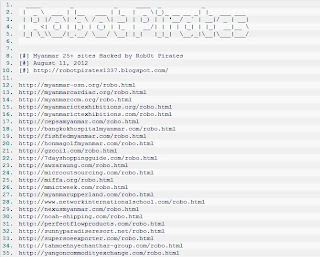
Link : http://www.paste.to/OTA2MTc4
Saturday, 11 August 2012
Reboot Film for Hackers and Cyber Lovers
Set within a dystopian world that is a collision between technology and humanity, “Reboot” touches upon many of the current social and political concerns that arise from becoming more and more intertwined with the virtual. In contemporary Los Angeles, a young female hacker (Stat) awakens from unconsciousness to find an iPhone glued to her hand and a mysterious countdown ticking away on the display. Suffering from head trauma, and with little recollection of who she is or what is happening, Stat races against time to figure out what the code means, and what unknown event the pending zero-hour will bring.
"A female hacker races against time to figure out the code on an iPhone that is glued to her hand"

Film Trailer:
If you peoples want to watch trailer in HD follow this link. http://www.rebootfilm.com/trailer

Tuesday, 7 August 2012
140+ Malaysian Site Hacked and Defaced By D4rkDriv3r aka DevilzSec
140 plus Malaysian Site Hacked and Defaced By D4rkDriv3r From DevilzSec. According to hackers Reason behind there hacker is just to show there skills to world. These kind of attacks are clearly showing how much awareness about security is need in cyber world.

The list of impacted sites was published on Pastebin yesterday, but at press time, most of them still weren’t restored.
Hacked Sites List: http://www.paste.to/ODY2OTAy
Follow @thehackersmedia
The list of impacted sites was published on Pastebin yesterday, but at press time, most of them still weren’t restored.
Hacked Sites List: http://www.paste.to/ODY2OTAy
Wednesday, 1 August 2012
Hackers Take Control of Two Satellites for Few Minutes
According to a US report recently claimed that hackers had managed to interfere with two military satellites, but one expert argues the amount of energy required would be too great for ordinary hackers.

But as satellite communications enthusiast Paul Marsh explained at the London Security B-Sides event in April, there are reasons to doubt the reports. He spoke about a similar story, reported in the late 1990s, about hackers supposedly accessing UK military satellite communications network SkyNet and ‘nudging’ one satellite out of synch.
Follow @thehackersmediaThe hackers took control of the Landsat-7 and Terra AM-1 satellites for a grand total of 12 minutes and two minutes respectively.

One might hope that the communications satellites suspended in orbit above the earth might be one component of the planet’s technology infrastructure that is safely out of harm’s way.
But as satellite communications enthusiast Paul Marsh explained at the London Security B-Sides event in April, there are reasons to doubt the reports. He spoke about a similar story, reported in the late 1990s, about hackers supposedly accessing UK military satellite communications network SkyNet and ‘nudging’ one satellite out of synch.
Whether Chinese hackers have that capability now is just one more matter of speculation to add to the opaque field of cyber warfare.
Tuesday, 31 July 2012
European Cyber Security at the Mercy of Chinese Hackers
Europe is “Under the watchful eye of Chinese pirates”, writes Libération,which picks up on a Bloomberg feature report on computer security breaches. The American press agency reveals that a group of Chinese cyberspies – which has been tracked by an American collective (that includes academics, companies that have been targeted by Chinese espionage and computer security experts) – succeeded in infiltrating a large number of institutions and companies last year.

The group linked to the Chinese military, which has been named “Byzantine Candor” by American secret services, notably managed to infiltrate European institutions, reports the French daily –
At a critical moment in the euro crisis in July, a group of Chinese spies remotely infiltrated the computers of the European Council, not once but five times. Launching their attacks from China, the hackers stole data including email correspondence with Herman Van Rompuy [...] Along with the European Council, the networks of at least 20 European businesses have fallen victim to Byzantine Candor [...] According to Bloomberg, most of the breached corporate networks were characterised by the fact that they contained information on innovation that could be economically advantageous to Chinese firms.
Libération adds that a decade ago –
… the usual targets for these kinds of attacks were American arms manufacturers [...] However, no one is safe today.
As a result, the drive to combat cyber-espionage is now a critical priority for Europe: notably in Spain, which, according to El País –
… is one of the countries that has been worst affected by hacking attacks, with tens of thousands of incidents every year.
The Madrid daily explains that a new national cybersecurity centre of excellence, financed by the European Commission and headquartered at the Autonomous University of Madrid, will be inaugurated in September. In the wake of the establishment of similar centres in Montpellier (France) and Dublin (Ireland), it will be the third of its kind in the EU.
However, the daily regrets that one of the companies tasked with the creation of the centre, CFLabs, is directed by Matías Bevilacqua –
… an IT expert who was arrested and charged in connection with purchase and sale of confidential data [...] and in particular sensitive information sourced from virtually all of the institutions of the Spanish state.
In conclusion El País wonders about the wisdom of appointing “a hacker to play a key role in such a sensitive project”.
Monday, 30 July 2012
8.7 million mobile customers hacked in South Korea
SEOUL — South Korean police have arrested two hackers who stole personal data of 8.7 million customers of the nation’s second-biggest mobile operator, the company said.
KT said the hackers — formally arrested on Sunday — had stolen data such as customers’ names, phone numbers and residential registration numbers for five months since February and sold the information to telemarketing firms.
“The number of affected people account for nearly a half of about 17 million customers of ours,” a KT spokesman told AFP, adding the company had alerted police on July 13 after detecting traces of hacking attacks.

Yonhap news agency, citing police, said the duo — including a former veteran programmer at a local IT company — had earned at least 1 billion won (about $880,000) by selling the stolen data.
Seven other people were also booked for buying the leaked data for telemarketing purposes, Yonhap said.
“We deeply bow our head in apology for having your precious personal information leaked… we’ll try our best to make such things never happen again,” KT said in a statement to customers.
Hacking attacks on major companies aimed to gain access to the personal data of their customers is a frequent occurence in South Korea, one of the world’s most-wired nations.
Seoul authorities said in July last year hackers using an Internet address registered in China had gained access to South Korean major websites including web portal Nate.com and may have stolen the private data of 35 million users.
In November 2011, Seoul’s top games developer Nexon saw personal information of 13 million users of its popular online game MapleStory stolen by hackers.
In March 2010, authorities launched a probe into the security systems of major retailer Shinsegae and 24 other companies after private data on 20 million customers was leaked.
Sunday, 29 July 2012
NSA Turns To Hackers To Make Internet Secure From Cyber Attackers
The National Security Agency has sought the help of professional hackers to render the World Wide Web more secure.
Reports from the PCWorld and Reuters indicate that General Keith B Alexander, Director, National Security Agency sought the help of hackers while addressing the Defcon hacker conference in Las Vegas July 27.

Speaking at the conference, General Alexander said: “This is the world’s best cybersecurity community. In this room right here is the talent our nation needs to secure cyberspace,” PCWorld reported.
Urging a collaborative approach to secure the cyberspace, Gen. Alexander, who also head of the U.S. Cyber Command and Central Security Service, urged hackers to partner with government and industry to realize the objective.
Stating that hackers can educate others who do not understand cybersecurity, the NSA Chief said: “You know that we can protect networks and have civil liberties and privacy and you can help us get there.”
The rare courtship of NSA Chief and hackers seems to have come on the heels of increased cyberattacks against U.S. cyber infrastructure. ThePCWorld report cited a 17-fold increase in cyberattacks reported against the Federal Government between 2009 and 2011.
Gen. Alexander urged the hacker community to continue building better tools that were needed to protect the cyberspace citing examples of Metasploit and other penetration testing tools, PCWorld added.
Seeking hackers support in defending the nation against cyberattacks, Gen. Alexander rued: “The issue is that if you don’t see a cyberattack you can’t defend against it and at the moment, the NSA has no insight if Wall Street is going to be attacked, for (an) example.”
Urging cooperation from the industry, Alexander called on the corporate to share at least limited pieces of information from their intrusion detection systems in real-time so that NSA could follow up such instances of aberration.
Gen. Alexander stressed on joint evolution of standards post-information sharing as the key to secure critical infrastructure and sensitive networks.
Gen. Alexander’s presence at the Defcon was hailed as a rare occurrence as Jeff Moss, Founder, Defcon, revealed
Thursday, 26 July 2012
Facebook offer Bug bounty To hackers, who find flaws in its systems
Several companies already reward 'white hat' hackers who responsibly report flaws in their web services, but Facebook is apparently going a step further with payments to those who find vulnerabilities in their internal systems

Facebook and Google have for some time offered bounties to hackers who find vulnerabilities in their public-facing systems, but now the social network has gone a step further by offering to reward hackers who find and report flaws in Facebook's corporate network.
According to a Bloomberg report on Thursday morning, the move will be announced at the DefCon hacking conference. "If there's a million-dollar bug, we will pay it out," Facebook security response chief Ryan McGeehan was quoted as saying.
The idea of a company paying so-called 'white hat' hackers to probe their sites and report flaws — rather than exploiting them — is rare, but far from new. Google and Facebook do it, as do Mozilla, HP and, as of last month, PayPal.
However, rewarding people for breaking into internal systems is an even riskier proposition. According to the Bloomberg piece, Facebook was moved to introduce the new bounty scheme after an external researcher informed the company of a flaw that meant outsiders could listen in to their internal conversations.
Facebook's bug bounty page says the company will pay a minimum of $500 for each responsible disclosure, as long as the bug could "compromise the integrity of Facebook user data, circumvent the privacy protections of Facebook user data, or enable access to a system within Facebook's infrastructure".
The only kinds of bugs that Facebook won't pay out for are those in third-party apps or websites, denial-of-service vulnerabilities, and spam or social engineering techniques, none of which Facebook has any control over.
Subscribe to:
Posts (Atom)